
 Clients
 Partners
 About us




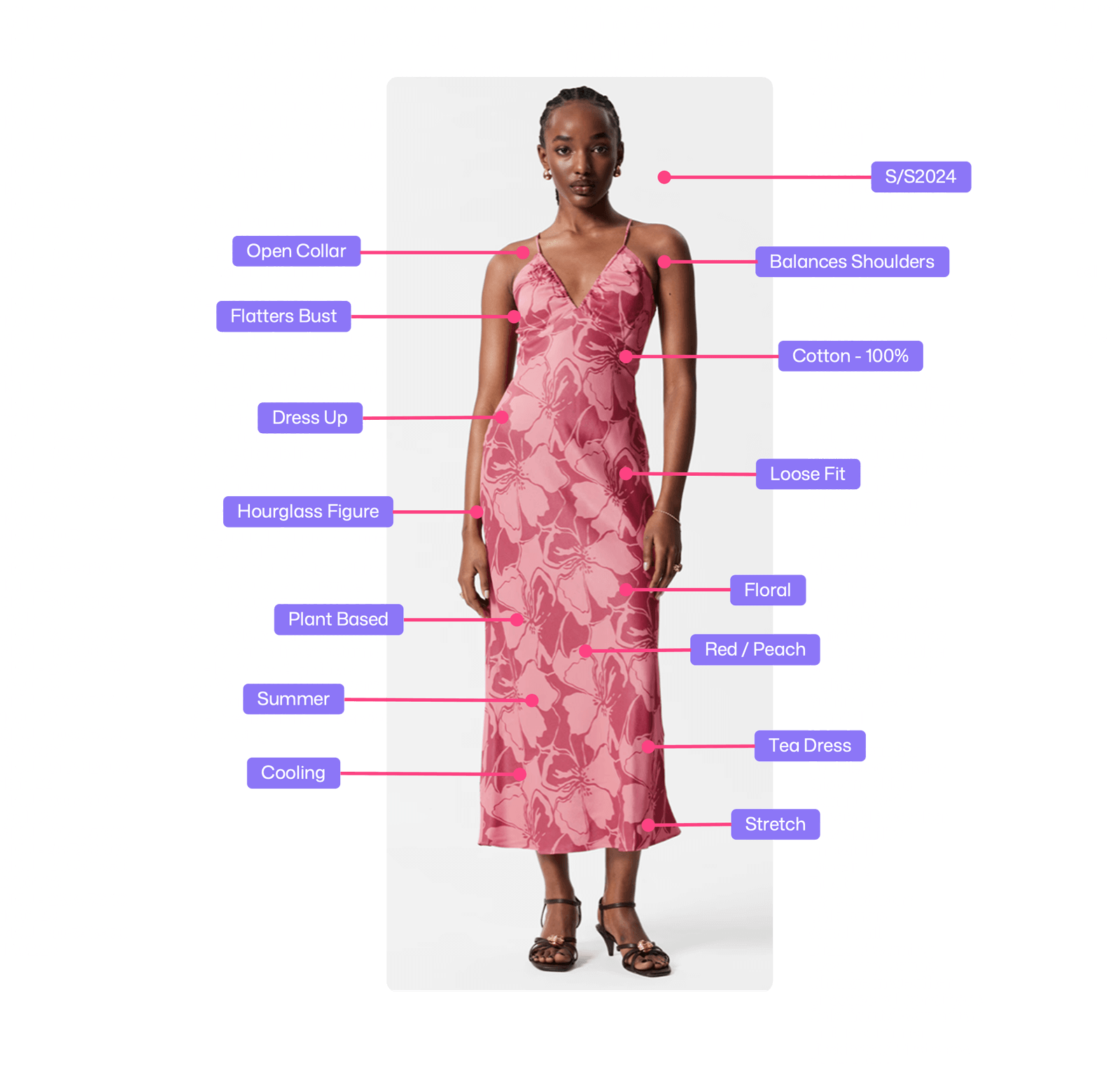
Fashion retailers are losing control of how products show up in AI summaries and shopping assistants. The challenge isn’t visibility. It’s fidelity.


Discovery still looks like search on the surface. But the mechanism has shifted.
When Google and chat-based assistants summarise products, they don’t “rank a page.” They assemble an answer. That answer is built from whatever signals look coherent: PDP copy, structured data, product feeds, reviews, schema, and third‑party references.
That changes the risk profile for fashion retailers. Your product can be seen and still be misrepresented.
This is no longer a visibility problem. It’s a fidelity problem.
Fidelity is simple: does the system describe your product the way your best merchandiser would? If not, you lose relevance at the moment the customer is deciding.
“Our SEO is solid, so we’re covered.”
SEO still matters. But generative systems don’t reward keywords in isolation. They reward consistent meaning across layers.
If your PDP says one thing, your feed says another, and your schema is patchy, the model doesn’t reconcile it. It guesses.
“Our product feed just needs to be marketplace-compliant.”
Compliance is table stakes.
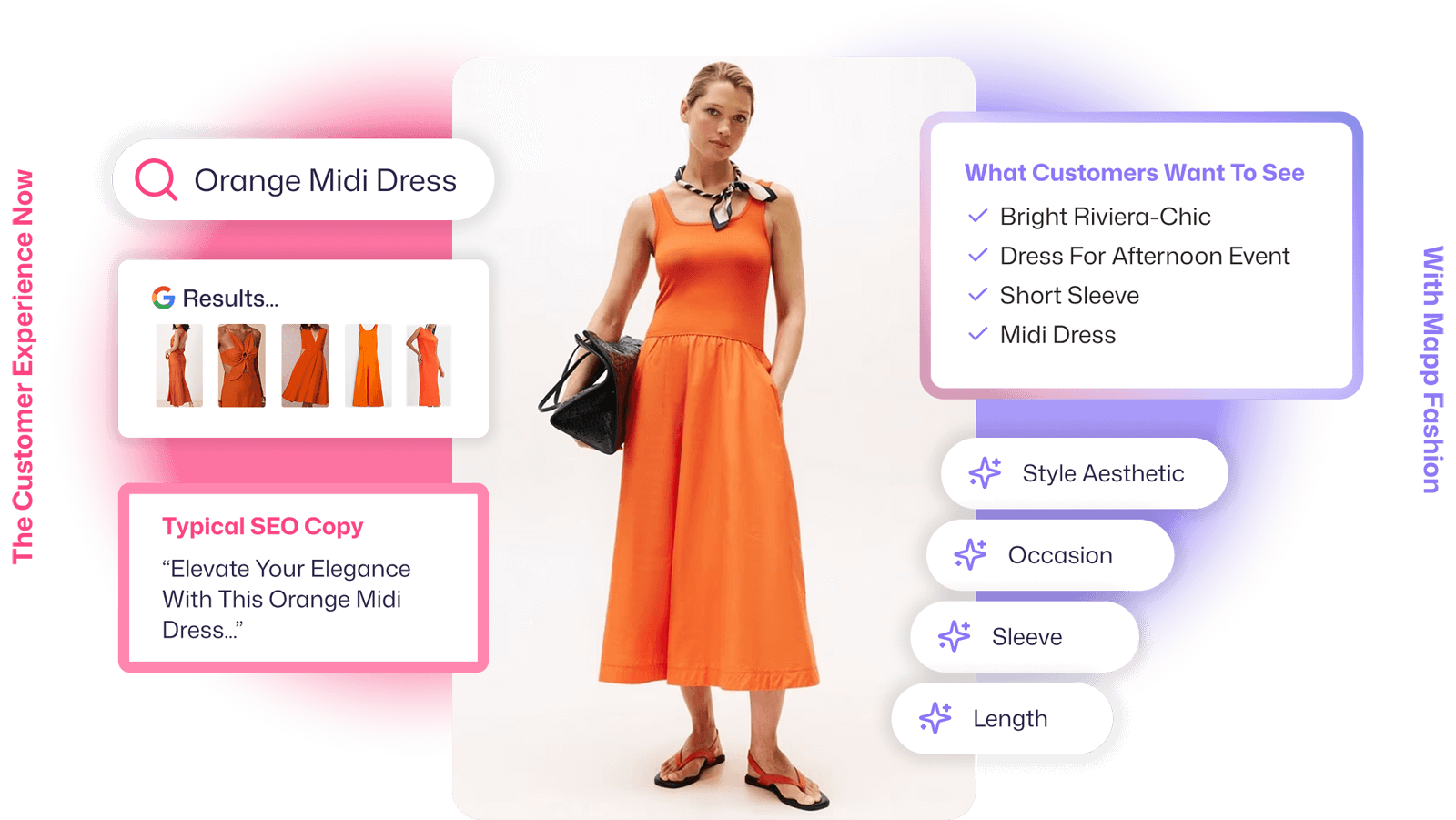
A feed can meet platform requirements and still fail in agent-led discovery if the language is vague, the attributes are inconsistent, or the taxonomy doesn’t match how people shop.
House of Bruar saw this in paid performance. Google Merchant Center flagged quality issues including Mismatched Availability (6.5%) and Mismatched Price (1.6%), creating wasted impressions and budget leakage.
The fix wasn’t a compliance audit, it was product clarity: enriching product_type with the language shoppers actually use.
The outcome was concrete: +38.1% ROAS, +51.1% revenue, and +9.43% CTR.
“Brand DNA lives in our campaigns, not our data.”
If your brand only exists in creative, the assistant can’t see it.
Mood boards don’t travel through product feeds. Product language does.
“AI discovery works like traditional search, so we just optimize for the algorithm.”
There isn’t one algorithm anymore.
The same product can be evaluated differently depending on the query context: occasion, tone, constraints, and even the customer’s tolerance for uncertainty.
The only sustainable defense is clarity: data that is consistent, context-rich, and hard to misread.

We analysed how ChatGPT’s Shopping Research feature recommended fashion products across three scenarios:
– A pastel March wedding in Alicante
– A Casino Royale themed Christmas party
– A business offsite dinner
The pattern was obvious.
The models weren’t matching on “tags.” They were translating human intent into product requirements.
For the wedding scenario, listings that named the occasion and the silhouette performed better: terms like “wedding guest,” “puff sleeve,” and “mini” made the intent legible.
For the themed party, “Casino Royale” was translated into a bundle of cultural cues: formal eveningwear, black‑tie energy, glamour, and celebration.
For the offsite dinner, the query wasn’t stylistic. It was functional. “Travel-friendly” was interpreted through feature clusters: wrinkle resistance, breathable fabric, durability, machine washability.
Once more, nuance matters.
Style-led occasions leaned on semantic alignment. Functional purchases leaned harder on proof signals (review count, rating volume).
Takeaway: agentic systems reason. They don’t just rank. Your product data has to carry both meaning and confidence.
Google’s Universal Commerce Protocol (UCP) is a signal of where this is going.
In an agentic journey, structured data isn’t an “SEO nice-to-have.” It’s how systems decide whether they can trust your product enough to recommend it, summarize it, or transact against it.
Each layer describes the same product slightly differently. That difference is invisible to a human. It’s decisive to a model.
When structure is fragmented, you create ambiguity. And ambiguous products get filtered out, simplified, or misclassified.
Structural clarity is not glamorous work. But it is commercial work.
Brand DNA is not a slogan. It’s the repeatable logic behind your aesthetic.
It shows up in silhouette choices, fabric preferences, fit language, tone, and cultural references. It’s the thing that keeps a brand coherent across seasons.
In generative discovery, that coherence becomes a retrieval advantage.
When a model tries to answer “modern tailoring for a senior offsite” or “minimalist eveningwear with a clean neckline,” it is reading your language to infer mood, formality, and intent.
Generic language collapses you into the category average. Precise language makes you detectable.
Ann Taylor saw this limitation with personalization approaches that leaned on “people like you” behavior rather than product understanding.
In direct testing, Mapp Fashion’s intent-led, feature-based recommender (built on consistent product attributes across physical detail, context, and trend signals) outperformed two competing vendors, including Salesforce Einstein.
The gains concentrated where it matters most: high-intent PDP sessions, where feature-level matching for suiting and workwear drives conversion.
That’s Brand DNA doing measurable work.
Most fashion organisations already have deep product knowledge. They just don’t encode it consistently.
Merchandising teams describe construction, material, and fit.
Marketing teams describe trends, moods, and seasonal narratives.
Performance teams translate products into platform templates.
CRM teams segment customers based on behaviour.
All sensible. All separate.
But agentic systems require semantic coherence across the whole stack.
If the customer asks for “a modern but comfortable outfit for a business dinner,” the model is evaluating occasion + mobility + tone.
If your PDP only lists fibre composition and your feed only lists marketplace attributes, you’ve made the use case invisible.
The cost of doing nothing means that a better-described competitor fills the gap.
You don’t “preserve brand DNA” with a workshop. You preserve it by standardising how the brand is expressed in product language and structure.
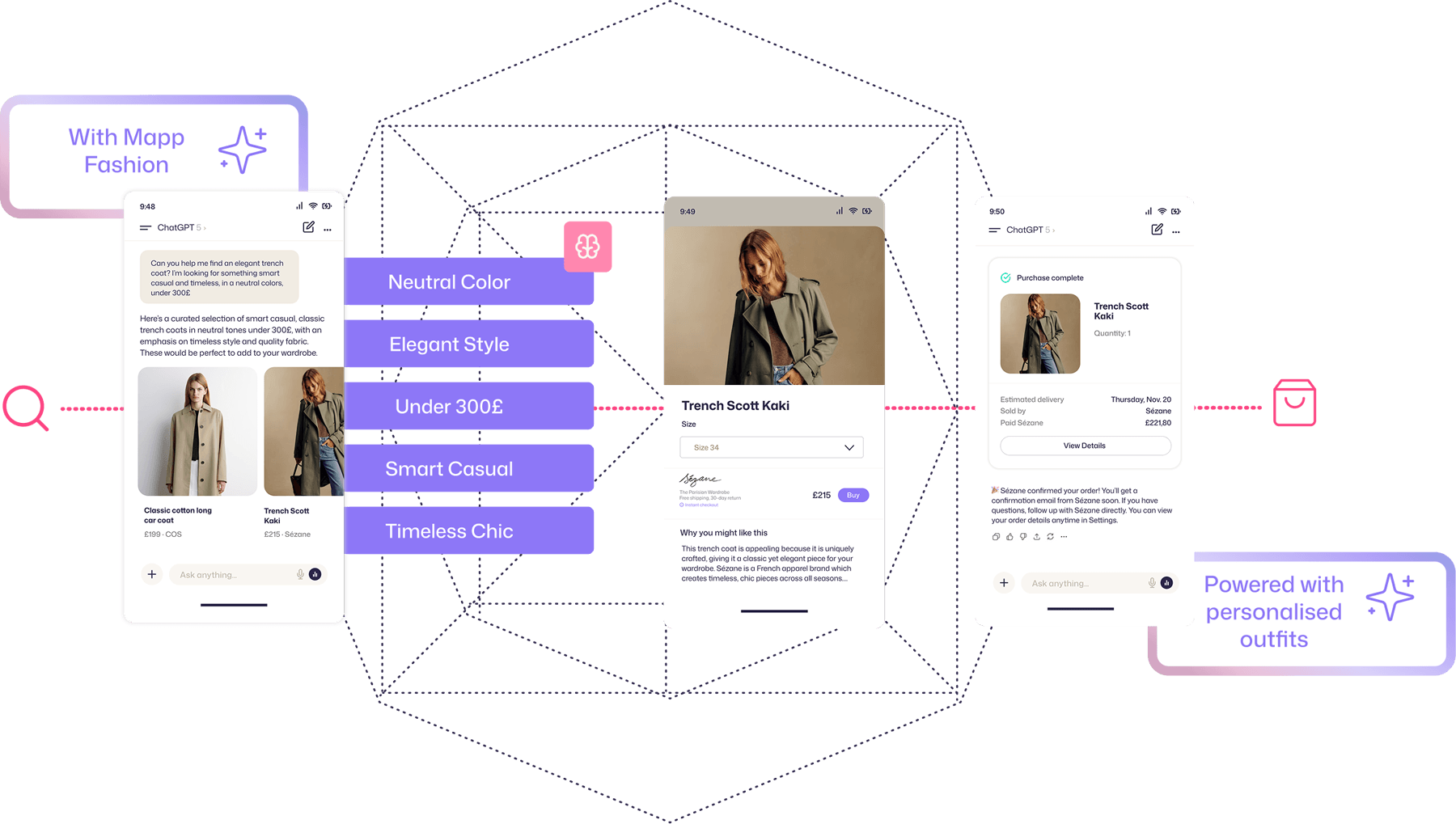
The shift is simple: product discovery is becoming interpretive.
That raises the bar.
If your products aren’t described clearly and consistently, you won’t just lose clicks. You’ll lose selection.
For most retailers, the next 30 days are not about replatforming. They’re about diagnosis.
If the answer is “not consistently,” that’s the work.
Mapp Fashion is built for exactly this problem: product data enrichment with fashion-native AI, backed by a stylist QA loop, so your catalogue carries the depth, accuracy, and brand coherence generative systems need.
See how Mapp Fashion improves product fidelity ›


 DE
DE