
 Clients
 Partners
 About us






April 22, 2026, London – Mapp Fashion, fashion market and product intelligence company, today published research across 397 online fashion retailers in seven markets revealing that the discovery model underpinning digital commerce for the past 20 years is breaking down. Paid search nearly tripled its share of sector traffic while operating margins declined across the majority of major retailers.
Fashion retail is among the largest consumer categories online, representing approximately $1 trillion of a $6.8 trillion global digital commerce economy. The data shows large-scale financial evidence of what happens when AI search changes the rules of online discovery.
“For 20 years, online commerce ran on a simple equation: more traffic, more revenue. That equation has broken. The brands still optimising for traffic are solving the wrong problem, and the data now shows what that costs.”, Sarah McVittie, Co-Founder, Mapp Fashion
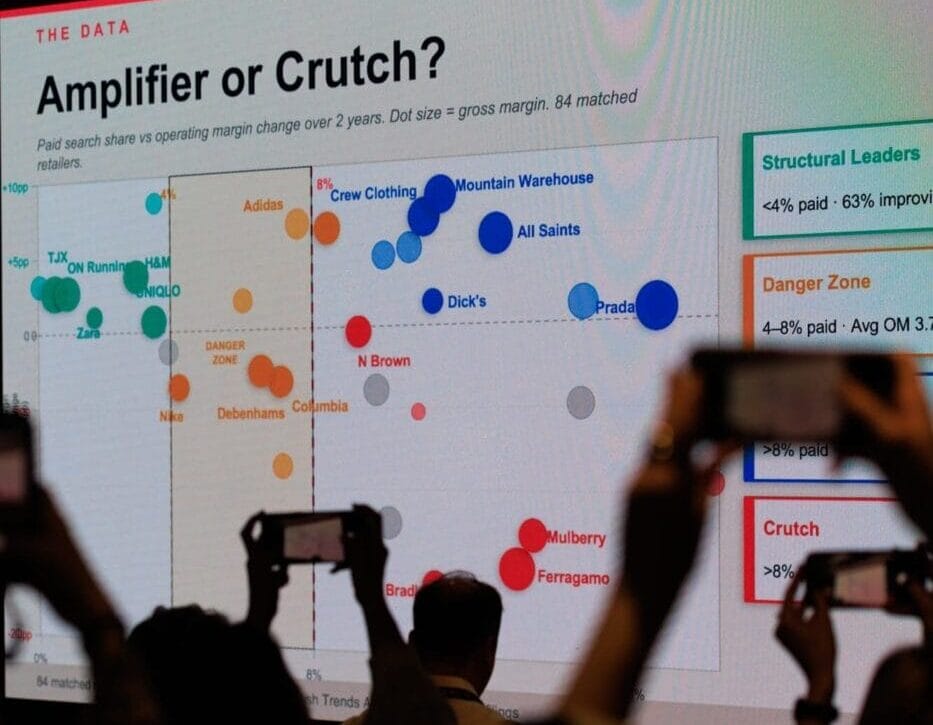
Paid search’s share of fashion retail traffic nearly tripled in twelve months, rising from 2.8% to 8.2%, while organic search contracted by 4.1 percentage points. 65% of fashion retailers show paid search dependency while their operating margins are declining by an average of 4.8 percentage points. The traffic is arriving. The margin is not. Paid search was designed to amplify demand that brands generate independently. For a significant portion of the sector, it has become the primary mechanism for generating that demand at all. The financial data now confirms what that costs. Of brands in the same paid dependency group, 35 are losing margin while 19 are gaining it. The difference is not spend level. The brands gaining margin average a 4.2 percentage point improvement and share one structural characteristic: more than 65% of their traffic arrives through channels they own directly, meaning customers who come back without being re-acquired through paid search. Where that base exists, paid search can still function as an accelerant. Where it does not, the data shows an average operating margin decline of 4.8 percentage points. The same paid investment produces opposite outcomes depending on what it is built on top of.
Sector traffic across 397 fashion retailers reached 53.7 billion visits in 2025, up 24.3%. Behind that number, paid search replaced organic traffic, and secondhand platforms captured brand search positions retailers had built over years. Across 84 retailers, more than half saw operating margins decline in the same period their traffic grew. Substituting earned traffic with purchased traffic at scale produces that result. Any retailer in any category measuring performance by traffic volume alone is working from the wrong number.
Social media measured at 1.57% of fashion retail traffic in this dataset. That figure is very incomplete. Traffic arriving via private messages and shared links leaves no referral data when it reaches a retailer’s site. It registers as direct traffic. The research estimates true social influence at 10 to 15 times the measured figure. Pinterest generated 7.1 million inbound referrals in this dataset against near-zero recorded investment from most brands receiving it. Budget decisions made on attributed social data systematically undervalue the channels doing the most invisible work. That measurement gap exists wherever social influence precedes a purchase.
ChatGPT referral traffic to fashion retail grew 172 times in thirteen months, from 17,572 visits in January 2024 to 2.9 million by February 2026. Of 397 retailers tracked, 340 are receiving none. They are not prepared for optimizing for AI.
The 57 brands receiving meaningful AI traffic share one characteristic: product information offered in a way AI systems can read and cite. AI discovery differs from search engine optimization. Search engines index pages. AI assistants recommend based on how completely a product is described in natural language terms. Position in AI-assisted discovery is earned through editorial quality, the way people engage with AI. More search spend or search word optimization has the opposite results.
Across these four findings, the pattern is consistent. The channels that drove digital commerce for twenty years are becoming less effective and more expensive simultaneously. The difference between the brands gaining margin and those losing it is not spend level. It is what that spend is built on top of.
“What makes this moment significant is that the new discovery channels, AI assistants, owned organic, social influence, are not yet dominated by anyone. The window to build a structural advantage in them is wide open. The brands that move now will not have to buy the position that others are currently paying to maintain.”, Sarah McVittie, VP Marketing, Mapp Fashion.
Fashion retail sits at the intersection of high transaction volume, publicly reported financials, and measurable digital traffic. What its data shows is arriving across digital commerce.
“We see the same pattern forming across digital commerce. Fashion retail has the data to make it visible first. Brands that built their discovery model on paid search are being kept oxygenated by it, dependent on a cost they cannot reduce without losing the revenue it funds. The window to build a different kind of model is open now, and not for long”, James Brooke, CEO, Mapp.
The Mapp report: ‘Who Owns Discovery’ report covers 397 online fashion retailers across seven markets, the United States, United Kingdom, France, Germany, Italy, Spain, and Australia, tracking 53.7 billion visits over 25 months of monthly data from January 2024 to February 2026. Data sources are: SEMrush Trends, modelled from a panel of approximately 20 million global users. Traffic figures are segment-level estimates; individual brand data points are directional. Financial data is drawn from publicly reported accounts of 84 matched retailers: 57 publicly quoted companies and 27 UK private companies via Companies House. Operating margin data is based on public, reported annual figures by the companies.
Discovery Pressure Index: https://mapp.com/cmp/fashion-discovery-intelligence-report/
For any questions, please reach out to me: sarah.mcvittie@mapp.com
About Mapp
Mapp helps businesses boost customer engagement by combining AI-powered insights with cross-channel marketing automation. With over 20 years of experience and trusted by 700+ brands like PizzaExpress, Geox, Turnbull & Asser, Umbro, and Furla, Mapp empowers marketers to create personalized, data-driven campaigns across multiple channels. Its platform makes it easy to turn insights into actions, optimizing strategies, and delivering measurable results.
Learn more at mapp.com
Press Contacts:
Mapp UK
Sarah McVittie
sarah.mcvittie@mapp.com
+44 7775755006



 DE
DE