
 Clients
 Partners
 About us




When a shopper asks AI for a "playful vibe" dress, it only finds what your taxonomy tells it to. The brands winning agentic search are the ones whose words match their customers' intent.

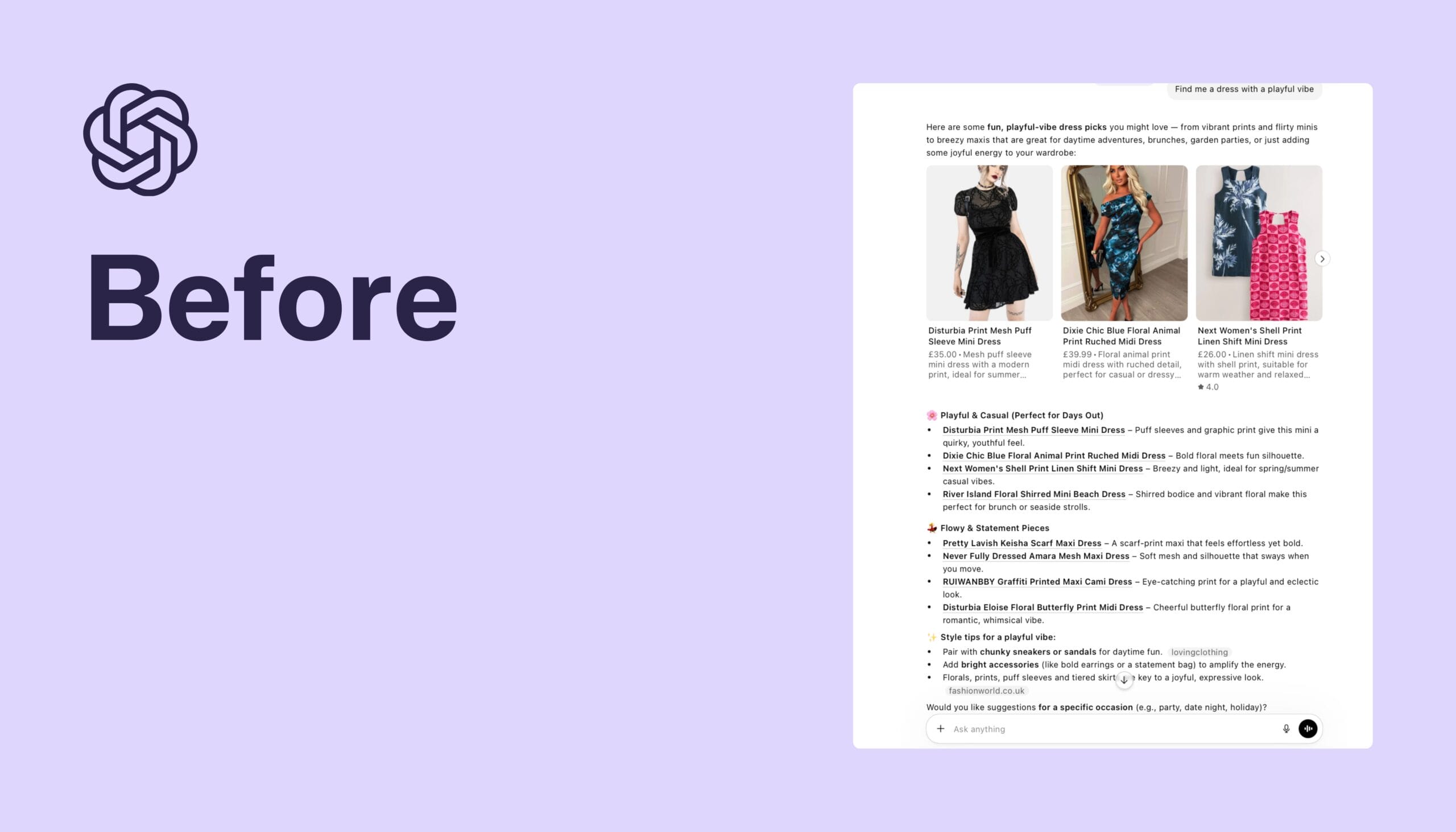
At the beginning of March as I anticipated the ‘Joyful’ tagline cover of Vogue’s spring trends edition hitting the stands, I was curious to see what ChatGPT would surface when prompted to “find me a dress with a playful vibe”. I specifically chose the word ‘playful’ because it reflected online sentiment associated with the joyful maximalist trend that emerged on the catwalks in September, and because I’d noticed ‘Playful’ listed on ASOS’s ‘What’s Your Vibe’ homepage content, with a black and white retro polka dot dress as the lead image.
ChatGPT surfaced lacklustre recommendations. No polka dots. No ASOS dress. AI did not recognise the concept of playful in this dress. The product language beneath this piece was not aligned with the customer language and most certainly not with what ChatGPT might be trained to perceive as ‘playful’. All the dots needed to be joined.
When it comes to your product AI will see what you tell it to see as well as what you tell it not to see. In a retail world driven by a quest to decipher customer intent, physical attributes alone will not guide agentic search towards your product. Now more than ever the richness of language used to talk about a brand’s product is an essential element of the AI models built to surface it.
Fashion is emotional and understanding a customer’s intent is the driving force of successful agentic search, which has moved beyond the bare physical attribute basics of SEO. Agents read your products’ structured data, the richer that data, the more accurate that data, the better the chances of your product and your brand surfacing in customer queries. Taxonomy embedded into brand catalogues needs to work in a way that fashion language + brand language + customer language are all aligned.
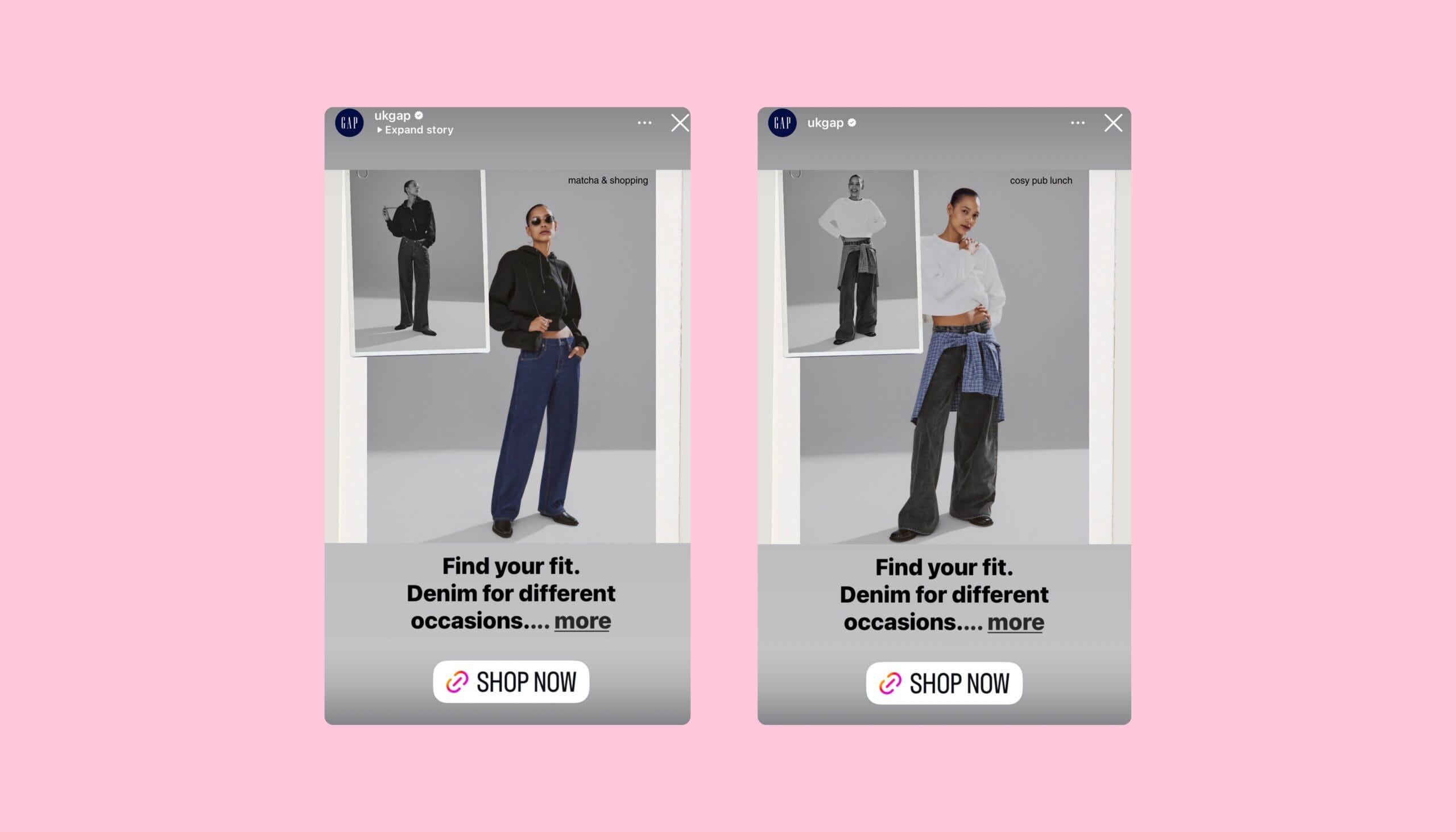
Have a look at GAP’s Instagram ad for their Denim Collection. In addition to marketing a particular fit and style of jeans, it layers in context with outfit ideas for occasions using the type of language customers might use amongst friends, on socials, and in search: ‘Find your Fit. Denim for different Occasions’: “Matcha Shopping”, “Cosy Pub Lunch” (no doubt different in the US), “Walk in The Park” and “Dinner & Drinks”. If these different sentiments are also mapped into each product’s taxonomy as well the marketing and any editorial created around denim through content creators and the brand itself, then GAP has built itself a strong agentic search proposition.
Every vertical has a version of this problem. Fashion is trickier. I know I don’t like Horror movies so Netflix will never be able to entice me otherwise, and I know exactly how to verbalise what movies I do like. Fashion is so nuanced because it is emotional and not static. Lifestyles change, preferences change, needs change. Shoppers might not always know how to describe what they are looking for in terms of physical features, but they can do so with more emotional, contextual language.
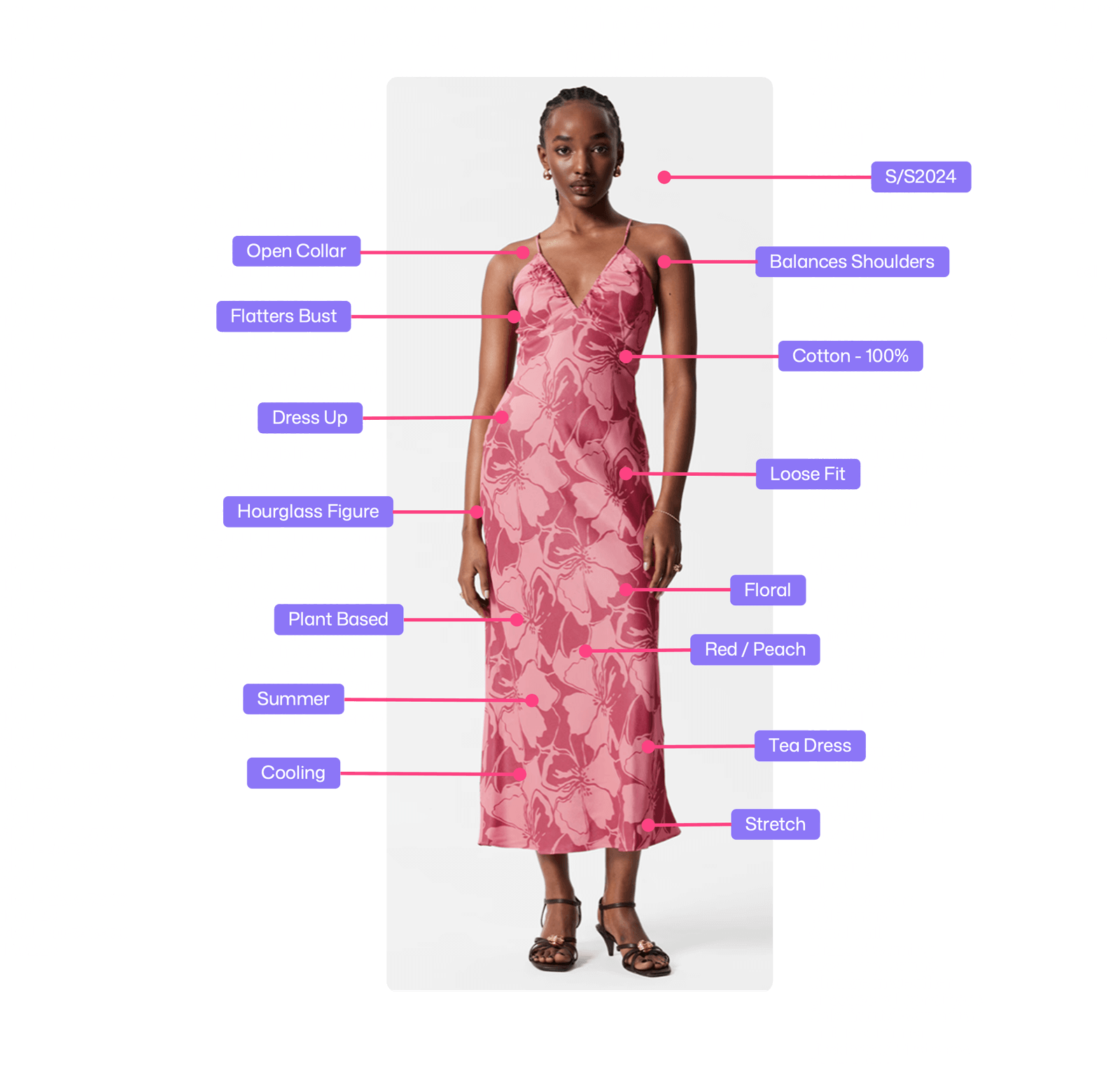
A grey cashmere V-neck jumper is so much more than a grey cashmere V-neck jumper. To someone looking specifically for a piece to balance out her broad shoulders it is a shape solution; to that woman who wants the longevity of a multi-tasking item in her wardrobe it is an investment piece; to someone looking to channel Librarian Chic, or Skandi Style or to dress like she’s borrowed a piece from her boyfriend, the humble jumper takes on a whole new meaning. Physical attributes alone are not enough.
Physical attributes are the foundation of a brand’s taxonomy; they need to be correct and consistent. Having rich, structured product data is irrelevant if the data is not accurate. More labels are only useful if those labels are correct. The math is unforgiving, and our CTO Eric Lubow laid this out clearly at Fashion Decoded. Accuracy compounds the same way errors do.
If your neckline label is 80% accurate and your sleeve length label is 80% accurate, the combined accuracy on a two-feature match drops to 64%. Add a third feature at 80% and you are at 51%. Rich product information with inconsistent labels is worse than sparse information with reliable ones. You are feeding the discovery engine confidently wrong information at scale, and the AI is believing you.
A generic language model working alone will get most things approximately right and some things completely wrong in ways a stylist would be able to spot immediately. A language model trained on fashion data, built on a stylist-curated taxonomy, gets the main features into the 80 to 90% range. Add in the essential layer of stylists reviewing the output, and this will achieve close to 100%.
Based on what we see in our own testing, the upside from richer, more accurate attributes is a 5 to 10% performance lift on a product.
To me our taxonomy is like my fashion cupboard – just think of those scenes in the Devil Wears Prada. Rows and rows of clothes are the attributes; clothes and accessories put into stories for fashion shoots are the contextual attributes. Brands have the ability to build a story into a product with taxonomy and when I look a retailer’s catalog for the first time, I am looking at their product and how I can break it down into our taxonomy.
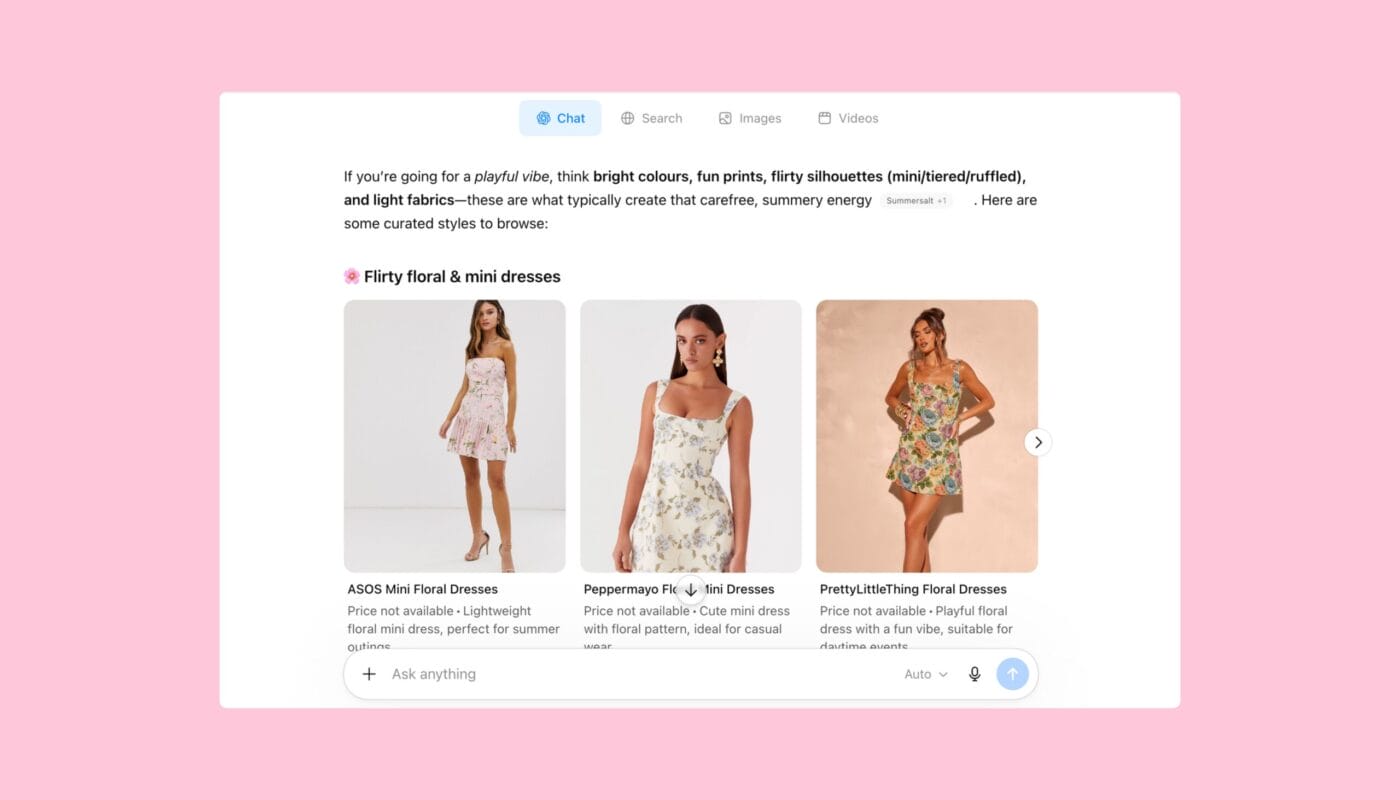
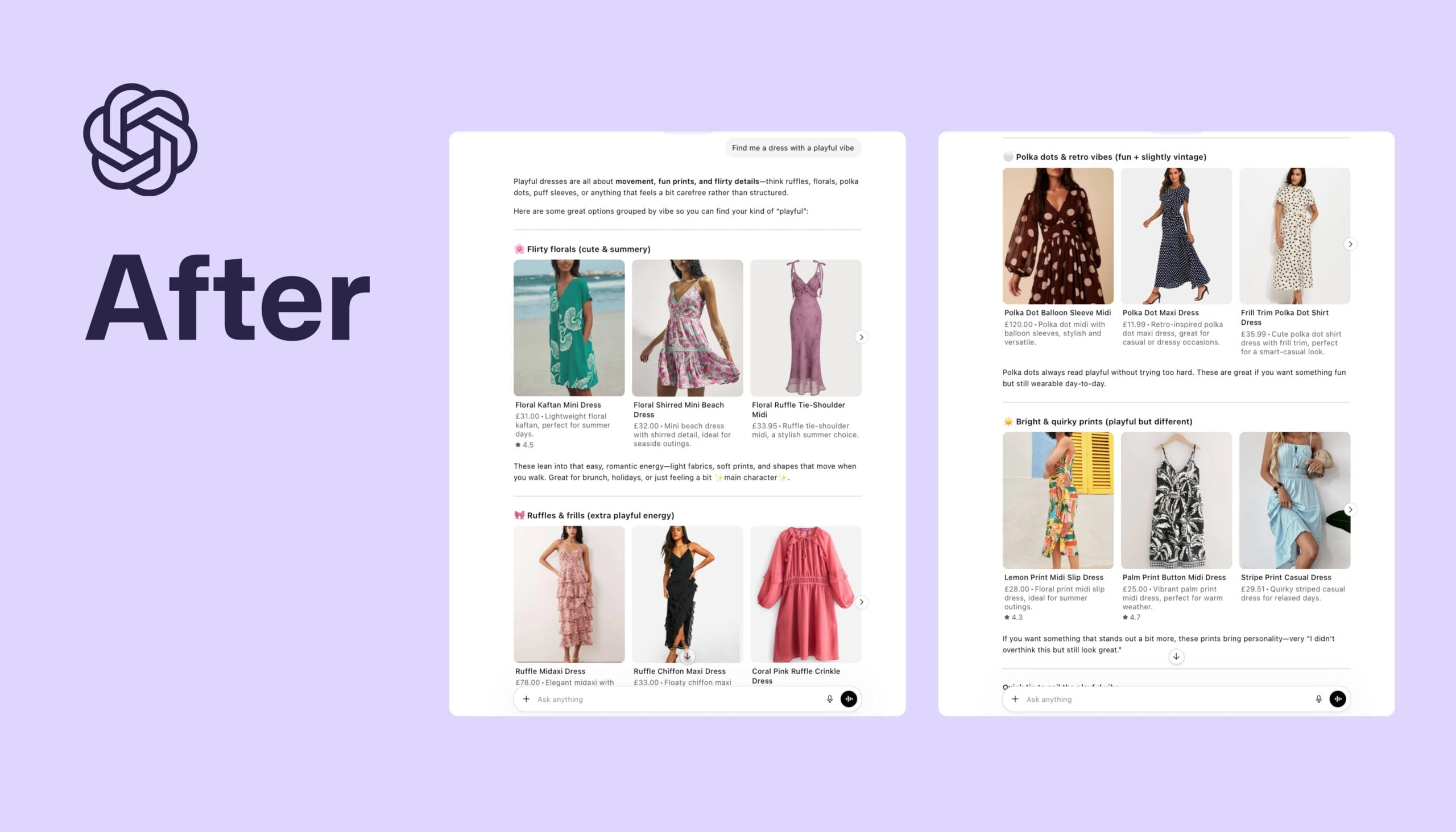
A couple of weeks ago I went back onto ChatGpt and asked the exact same question. And things had changed. This time rather than a handful of dresses, the AI surfaced a set of playful vibe themes for me to choose from namely: Flirty Florals; Bright Quirky Prints; Ruffles & frills… and …Polka Dots & Retro Vibes. Alas the polka dot dresses were from Amazon, New Look and DressMeZee. Someone at those brands had been doing their ‘playful vibe’ taxonomy homework.
The customer asking for a playful dress on ChatGPT is going to land somewhere. The only question a fashion brand should be asking is whether she lands on your site, or on somebody else’s. That answer starts with the words you use to describe your clothes.
At Mapp Fashion we build the words. Taxonomy, enrichment, stylist-curated labels, brand-specific attributes, and the accuracy layer that keeps all of it reliable at catalog scale. If you want to see what your product data looks like through a stylist’s eyes, ask us for your DPI score.



 DE
DE